

(First, Happy New Year, and welcome to the first of my weekly musings here on Substack. In these posts, I’m hoping to flesh out and reflect on what I’m learning and what I’m wondering as I travel my personal journey to understand this moment and what appears to be coming. As a reminder, paid members (and workshop registrants) will also get a Sunday rundown of the week’s most interesting, provocative, and useful links and resources with some practical navigational tools and strategies for personal and professional growth thrown in. Keep an eye out for some special community events throughout the year as well. As always, please use the comments or the chat to reflect, ask questions, or share your own journeys. Thanks again for being here.)
Let me just say straight up that while I’ve been focused primarily on family these past couple of weeks, the time I have allowed for reading and reflecting has felt especially intense. It might be something about the holidays that puts us into a space of deeper reflection. For many of us, “next year” may be the longest term thinking we do, attempting to articulate what we might accomplish by the following “new year.” But for many in my orbit, it’s about articulating the next 10 or 20 or 50 years in terms of when the shit is really going to start hitting the fan.
In case you haven’t read my manifesto, I don’t think it’s a matter of “if” we’ll all be facing some serious hardship in the near future. It’s more a matter of “when.” And in my networks, the growing conclusion seems to be sooner rather than later.
For those of you who have already been making forays into the deep end of collapse offerings and have built up some coping mechanisms, here’s an “interesting” breakdown (literally) of the next 50 years.* (By the way, I don’t mean to be glib about what is an incredibly serious topic, but for sanity’s sake…)
It appears to many that the changes that are conspiring to push us toward the brink are speeding up. There is a real concern that we’ve breached seven of the nine “planetary boundaries” that sustain life on earth, and that as these systems continue to denigrate, it will grow nearly impossible to recover them. Because of this, some are suggesting that 2025 may be the year that things start to get much worse much faster. (Just a note…let’s remember that for billions of people around the world, collapse is already well underway…they’re likely not reading this essay.)
And then there are others who see a slow descent into chaos fueled by crop failures, wars, supply chain breakdowns, pandemics, etc. (I wonder if fast might be better.)
All of which is to say that no one knows for sure exactly when the break will come or how fast it will be. But the growing consensus is that it’s coming.
Now, that may come as a surprise to many who aren’t reading in these spaces, because you don’t really get this version unless you look for it. Understandably, hardly anyone in government, corporate, mainstream media (whatever is left of it) or, yes, education wants to come out and say something along the lines of “The trends are clear. The science is compelling. There’s no political will to do what we need to fix it. We are facing the end of the world as we’ve known it, and we better get ready for a very different way of existing on the planet.”
No one wants to hear that. It’s bad for business. Literally.
Which frankly is another reason why I think those who are predicting “sooner rather than later” are probably right: precisely because we don’t want to talk about what we’re facing. We don’t want to read about it. We don’t want to feel the discomfort that comes along with even flirting with the idea that our near futures (and our kids’ longer futures) may not be well lived. But if you think thinking about it is uncomfortable…
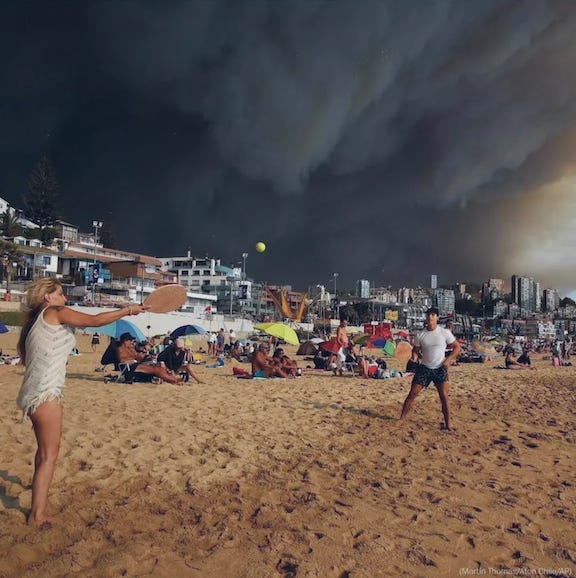
Our Western, educated, industrialized, rich, democratic (WEIRD) societies are like that couple on the beach in the picture above, refusing to give up the game despite the severe weather that’s approaching. Move along, nothing to see here…
Well, we’re going to talk about it and read about it and prepare for collapse here, and maybe, in our own way, slow it down a bit. Or at least be better prepared, and get our kids better prepared than most. Whenever it may come.
I’d love to hear in the comments the extent to which you’re engaging in these conversations with your colleagues, constituents, and family members. How does it feel for you? What are the sticking points? What strategies are working?
(*You may wonder what my process is for vetting the sources that I link to in these conversations. I plan on writing a future post on just that topic. )
Engaging in these conversations with colleagues is often frustrating. International schools almost always describe themselves as risk-takers taking a leadership role in education. And yet these same institutions, and their employees, often continue as if nothing is wrong. Look for swag, lots of plane trips, conspicuous consumption, and business as usual. People respond either with courtesy/patience, or with some expressed concern, but behaviors do not seem to change.
Talking to students about our situation is even worse. I get that students (and their parents) want for students a chance to participate in the same system that has previously rewarded their families with success. Whoever said, “It is easier to imagine the end of the world than the end of capitalism,” (Fisher or Zizek) got it right. In general students cannot or will not digest the horrible position that we are being put in by late-stage capitalism. The result is status quo.
So we continue on, headed for a cliff… we live in a world making essentially the same choices that led us to this point. It is insanity. Insist on the conversation and be marginalized. Pretend that we will fix our problems and be deluded.
Where to start - I think we need to rethink and redesign it all, to make it fit for purpose: to me the bottom line is that schools should serve Life on planet Earth. Period. Not just to prepare our young for good jobs or continued entitlement, for which we have developed such compelling rhetoric to disguise it. If we keep our eye on the bottom line and see our schools as ecosystems composed of living beings, interacting with living systems around us that nourish us, clothe us, keep us warm and entertained, if we do that, we might find our way to focus on the soil of learning, rather than the yield - if we focus on curiosity, compassion and courage in a real world context, where students are solving REAL local problems in collaboration with local stakeholders and living systems, maybe we've got a shot of turning this collapse into a big sigh of relief.
It IS hard to imagine the end of capitalism, or neo-feudalism, which it has become. I guess we have to work harder at imagining and invite our students around the table!