
Future Serious Resources for May 21, 02026
Axial Age ⊗ Images ⊗ Collapse Revisited

Hey,
PROGRAMMING NOTE:
Apologies. Life is getting in the way. As is my brain. Posting will be sporadic here for at least the next two weeks as I’m dealing with some family and life stuff. Hang in there with me, ok?
SUMMER REGISTRATION OPEN!: Reminder: My Confronting Education Workshop is now open for registration. I hope you’ll consider joining us for Cohort 5 of the workshop, which starts on June 26. If you’re feeling all the world craziness and the struggles education is having to deal with it, you’d be in the right place. Early Bird pricing through tomorrow, May 22. Reach out with questions.
FINALLY: As always, thanks for reading. As a reminder, all posts here are free, but if you want to show your support for my work in general, a paid subscription is always an option. Remember: I’m donating all proceeds from paid subscriptions to my local food pantry ($247.50 so far for 2026…) at the end of the year.
With gratitude,
~Will
The Second Axial Age
According to Otto Scharmer, writing in Noema, we’re entering a moment in civilizational history that only has one precedent, and that happened 2,500 years ago. “Axial” refers to a pivotal period in world history, and it’s hard to argue that we’re not deep into some existential shifts that are changing the arc of humanity and the planet:
We are living through a moment of radical depletion of our social soil. Three symptoms summarize this condition: Anomie is the erosion of our moral norms, the collapse of our ethical behavior. Atomie, the breakdown of social bonds into loneliness and polarized echo chambers, is the collapse of the relational web of connections on which society depends. Atrophy is the gradual loss of the deeper human capacities needed to create, converse and collaborate in ways that embody our humanity. It is the collapse of agency itself, both individual and collective.
Beneath all three lies a fourth dimension that connects them. Just as industrial agriculture replaced the diversity of the living soil with chemical fertilizers and crop monocultures — productive in the short term, devastating over time — the current AI moment is producing an epistemic monoculture. It manifests in a single, computational form of knowing that views the world as a set of objects.
The quality of the human-AI interface is sure to shape the future of society and humanity. More than $2.5 trillion is projected to flow into AI in 2026 alone, yet the human side of the equation — the cultivation of sensing, relating and sensemaking — receives almost none of it.
This is soil depletion at a civilizational scale. We see it manifest in the deepening of ecological devastation, such as climate change and biodiversity loss; in social divides, including polarization and war; and in spiritual consequences, like hopelessness and feelings of insignificance. And so we find ourselves at a threshold, one where the planetary polycrisis demands not just better policies or technologies, but a shift in our structure of consciousness.
I think the metaphor of “social soil” works well here. And describing the emergence of AI as an “epistemic monoculture” is apt (unless of course you’re thinking about and using AI differently from most).
Images of Collapse and Regeneration
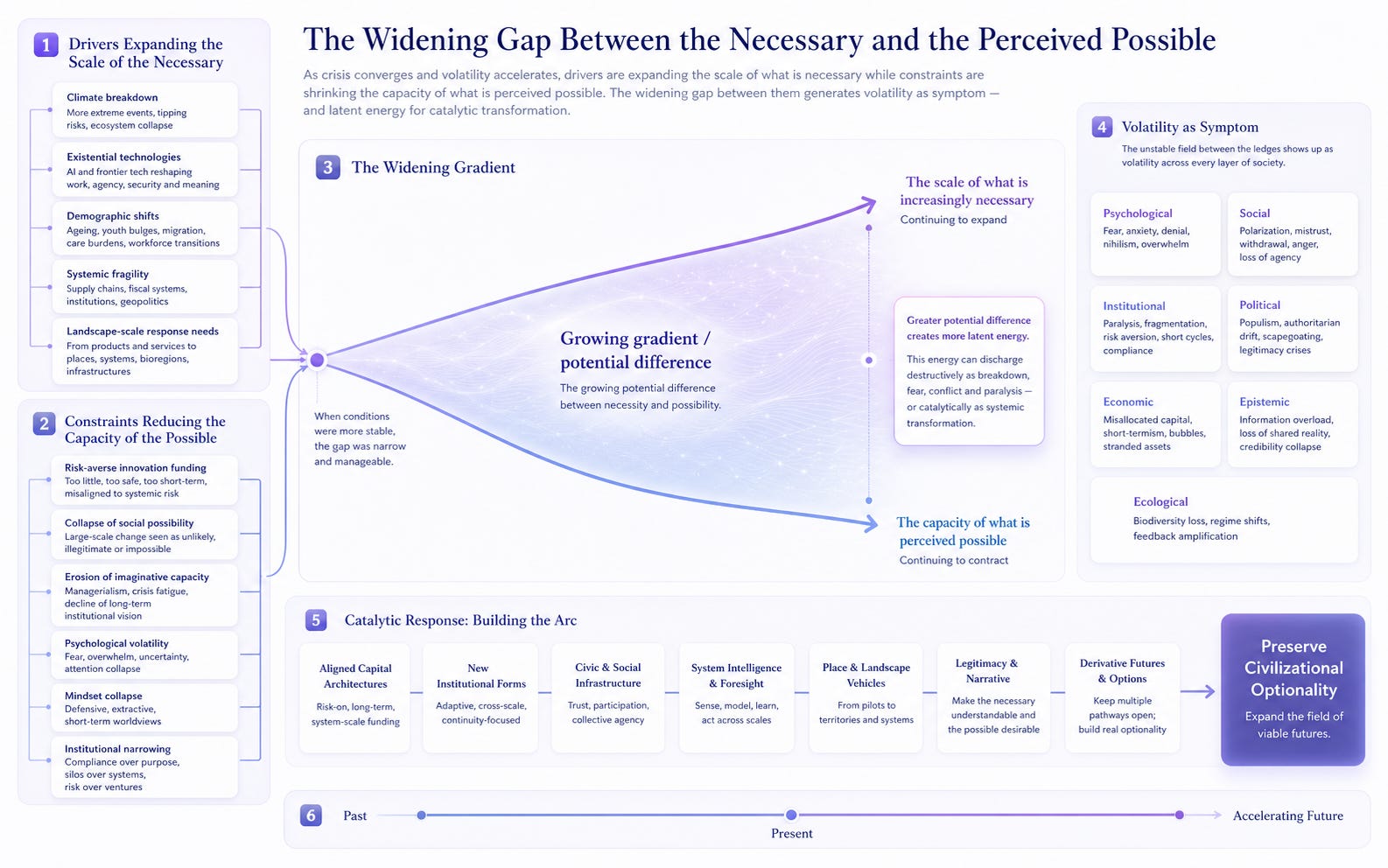
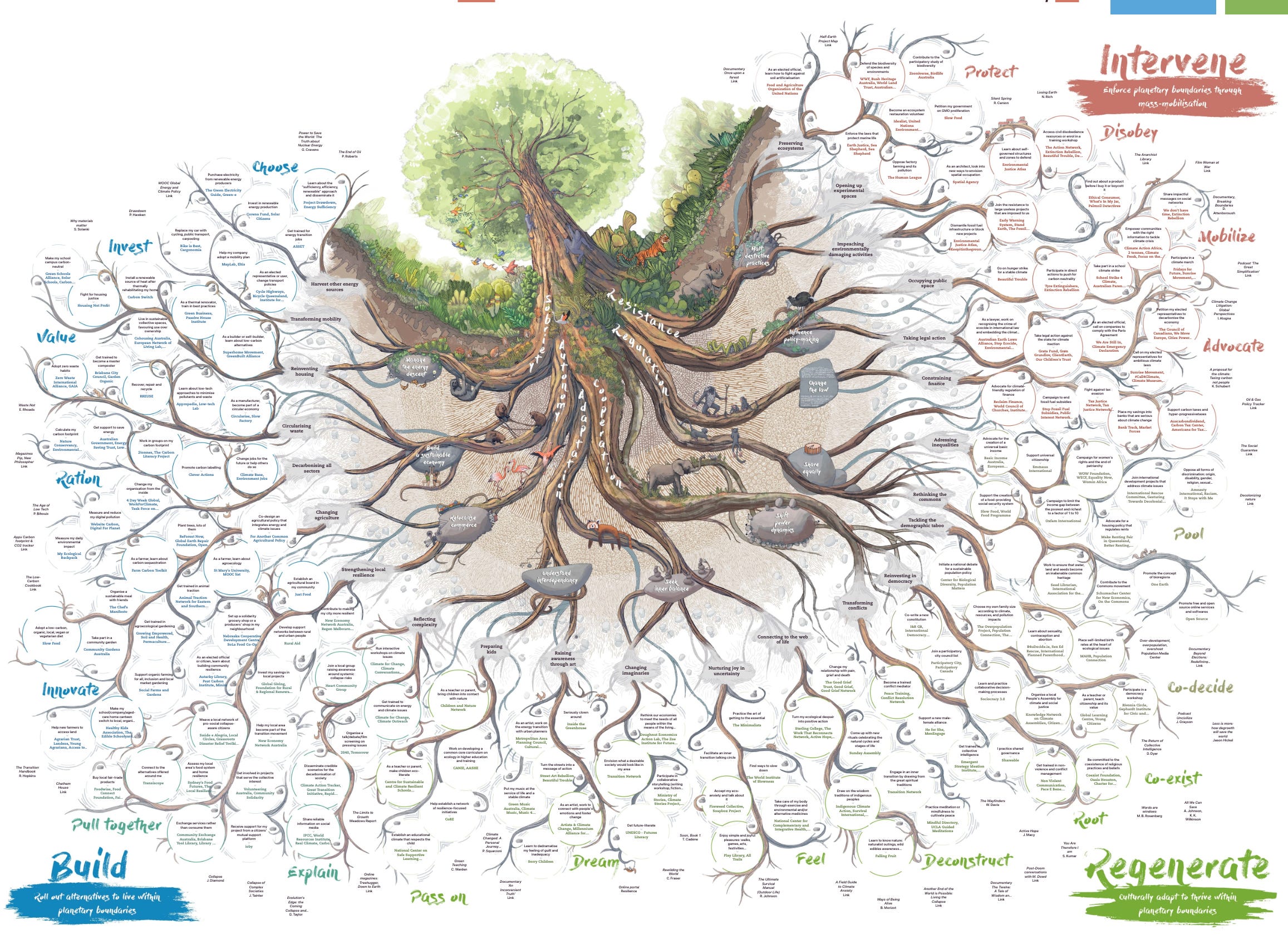
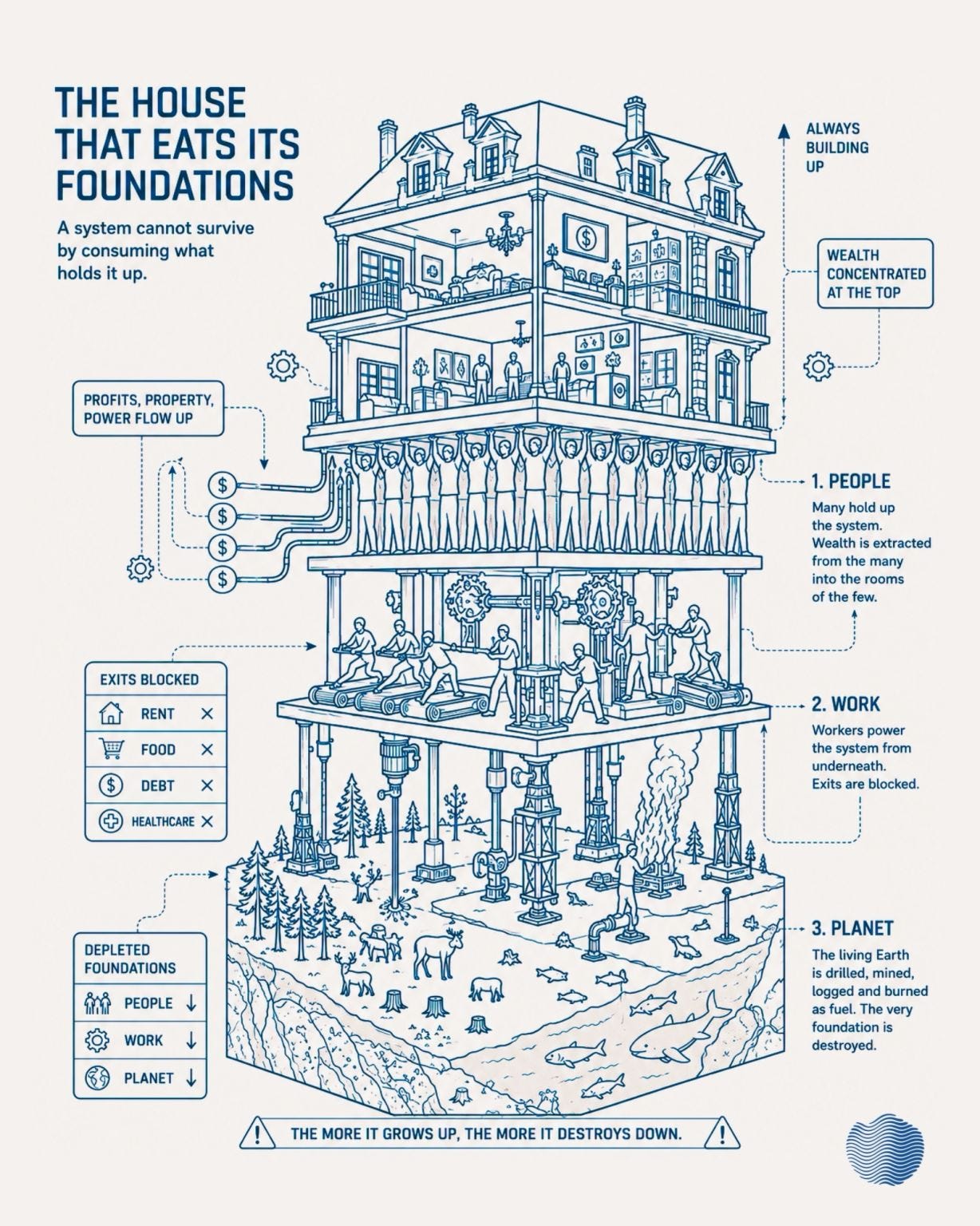
For whatever reason, I’ve come across a number of thought-provoking images in the last week or so that cover both the challenges and the opportunities of this moment. I’ll add them here with links, but with little comment, as I think they pretty much speak for themselves.
First, from Indy Johar on our atrophying ability to imagine what we need to navigate this moment:
Second, from Roots of Resilience on the good works that many around the world are doing (click the link and have fun zooming around):
And, finally, from Kasper Benjamin on the violence of capitalism:
Which speaks to you the most?
When the World “Collapses”
Few are more direct when it comes to staring down the realities of this moment and offering thoughtful yet confronting assessments of how we got here and what’s actually happening than Rachel Donald. Her latest essay is worth reading in its entirety (as are most that I link in this space), but this snip is especially compelling, I think:
Indigenous wisdom warns against thinking in event horizons and instead impels us to consider the great physiological web that cocoons and shields us first: collapse is not the sudden drop on a graph, or midnight on a doomsday clock, or a binary comparison between then and now and then again. Collapse is the gradual and subtle erosion of our social fertility, of our ability to live well together where we are. Like soil erosion, this erosion first sweeps away the top soil, exposing the roots of a place to the elements, undermining their ability to dig in deeper and hold on, rendering them vulnerable to change, to shock, to loss; making dust of our bonds.
In the great neoliberal fantasy of Thatcher and Reagan, we have been eroded to that dust, swirling around each other as independent motes of impotence. It is not the world that will collapse but we who have been undone, and our great, invisible undoing over the many centuries in which capitalist values have dug themselves into our bodies and wrenched us apart from one another have shepherded the great undoing of the world upon which we depend, a great interlinking of the many worlds we once inhabited and cared for, as human beings have always done. Human beings secured themselves throughout history where our hominid cousins failed because we figured out how to produce the conditions for life to thrive. We gardened our way across the world, making living pathways for our kinfolk to follow. That green thumb is our living inheritance, but in so many places around the world it has become nothing more than a fossil. We cannot recover ourselves until we recover it, until we recover this way of being.
That is the work, no doubt.
Thoughts / Reflections / Questions / Shorts
The ecological crisis begins with how we see ourselves in nature - Spread the word.
The Dictionary of Radical Alternatives - Love this. World-expanding stuff.
Question:
Everything You Do Is Being Recorded - In case you didn’t already know that.
Can California’s new online platform help rebuild democracy? - An emergent glimmer of hope.
As always, let me know what you’d like to see more (or less) of in these newsletters. I’m always open to learning and evolving in ways that help you make better sense of this interesting moment.
With gratitude,
~Will